Two traders open the identical position: long BTC at 10x, R20,000 of their own capital controlling R200,000. Same entry, same size, same conviction. A month later, one has paid roughly R563 to hold the trade. The other has paid R1,825, and if the market turned euphoric along the way, closer to R18,000.
Neither trader is smarter. They picked different rails. Leverage is not one product with one price; on a modern exchange it is two products with two completely different billing models, and most traders never compare them. This article puts the two bills side by side.
Rail one: the perpetual
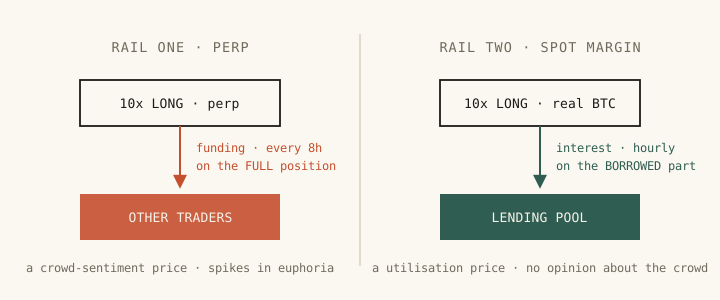
The perp is the default. Deep liquidity, up to 100x, one click. Its running cost is funding: every 8 hours, one side of the market pays the other to keep the perp tied to the spot price. When longs are the crowd (usually), longs pay.
The funding explainer covers the mechanism. What matters here is the billing model:
- Funding is charged on your full position size, not your capital. At 10x, a 0.01% funding rate is effectively 0.1% of your margin, every 8 hours.
- The baseline 0.01% per 8 hours annualizes to roughly 11% of the position per year (three settlements a day, 365 days). On the R200,000 position, about R1,825 a month.
- Funding floats with sentiment. Euphoric markets routinely print 0.1% per 8 hours, which is 9.1% of the position per month. At 10x, that pace consumes an entire margin deposit in about five weeks, before price moves at all.
The perp's price tag is small print that compounds. It is the rail built for speed, and it bills like it.
Rail two: spot margin
The quieter alternative sits in the same account. Spot margin means you borrow the money and buy actual BTC: post your R20,000 as collateral, borrow the rest in USDT, and buy R200,000 of real coins on the spot market (up to 10x on Bybit's unified account).
The billing model is a loan, and the difference is structural:
- You pay interest, hourly, on the borrowed amount only, not on the whole position. Your own R20,000 rides free.
- The rate is not a crowd-sentiment auction. It is a lending-pool rate that moves with utilisation, and it is dramatically calmer. At the time of writing, USDT borrows at about 0.0004% per hour, which annualizes to roughly 3.75%.
- On the same R200,000 position (R180,000 borrowed), that is about R563 a month.
The bill, side by side
Same trade, R200,000 long BTC at 10x with R20,000 down, using live rates at the time of writing:
| Perp (calm market) | Perp (euphoric market) | Spot margin | |
|---|---|---|---|
| Rate | 0.01% / 8h | 0.10% / 8h | ~3.75% / year |
| Charged on | full R200,000 | full R200,000 | borrowed R180,000 |
| Cost per month | ~R1,825 | ~R18,200 | ~R563 |
| Cost per year, vs your R20,000 | ~110% | ~1,095% | ~34% |
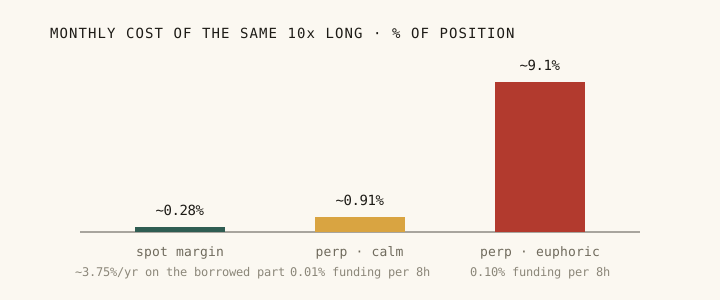
Read the last row again. At today's baseline rates, the same trade costs about three times more on the perp, and the gap explodes when the market heats up, because funding spikes exactly when everyone agrees with you. The borrow rate has no opinion about the crowd.
Both numbers are live on our home desk panel, updated every minute, side by side.
So why does the perp exist at all?
Because each rail is built for a different job, and the perp genuinely wins some of them:
- Short holds. For a trade measured in hours, funding is one or two settlements and rounds to nothing. The perp's liquidity and speed win.
- Higher leverage. Spot margin tops out around 10x. Everything beyond that lives on perps (and dies there quickly; a 25x long is ~3.5% from liquidation).
- Negative funding. When the crowd is fearful and short, funding flips: longs get paid to hold. A patient long on a perp during deep fear collects a subsidy that spot margin can never pay, because a loan never pays you interest.
- Shorting works differently on each rail. A perp short is one click. A spot-margin short means borrowing BTC itself, which currently costs a remarkable ~0.4% a year, a detail worth knowing before paying short-side funding.
The pattern: perps price speed and crowd positioning; spot margin prices time. Traders who hold for weeks are usually on the wrong rail without knowing it, quietly paying the speed premium for a position that is not going anywhere fast.
The checklist form
Before opening a leveraged position you intend to hold for more than a day or two:
- How long do I realistically expect to hold this?
- What is funding printing right now, annualized, and what is the borrow rate? (Both are on the desk panel.)
- At my leverage, what does each rail cost per month against my own capital?
- If the market runs euphoric while I am in the trade, which bill am I holding?
Five minutes of arithmetic, once, and the same trade can cost a third as much to carry. On a unified account both rails sit behind the same balance, so the choice is a dropdown, not a migration.
Education, not advice. Rates quoted are live readings at the time of writing and change continuously; check current rates before relying on them. Crypto assets are high risk; leveraged trading can lose more than your initial margin. Nothing here recommends a position, a leverage level, or a holding period.