Every yield number in crypto is an answer to the same question: what am I being paid to carry? A bank deposit pays you to lend to a bank. A government bond pays you to lend to a government. When a crypto product offers 8% on a stablecoin, someone, somewhere, is paying that 8% because they want something from your capital. Your entire job, before the deposit, is to find out what.
The graveyard is well populated. Celsius offered double digits and called it safe. Anchor offered 20% on UST and called it sustainable. Both numbers were real, right up until they were not, and the people who lost everything were mostly people who never asked what the yield was payment for.
This is not an argument against yield. It is an argument for reading the label. Five risks cover most of the landscape.
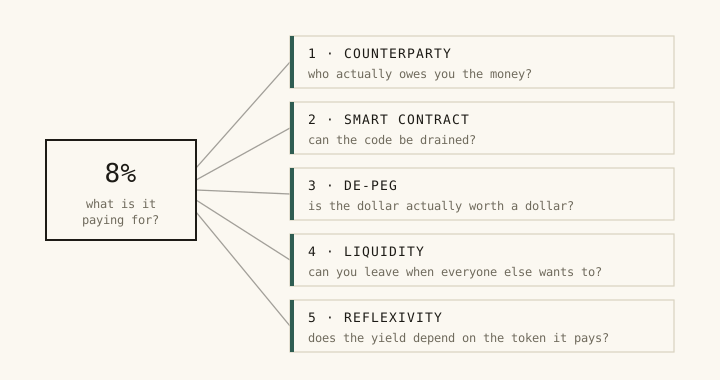
1. Counterparty risk: who actually holds your coins?
When you deposit into a centralised earn product, you are making an unsecured loan to a company. The APY is their borrowing rate. If they gamble your deposit badly (Celsius) or run a fraud (FTX Earn), you stand in the bankruptcy queue behind the lawyers.
The check: can you name the entity that owes you the money, and what happens to your claim if they fail? If the answer is a shrug, the yield is not an interest rate. It is a loan to a stranger.
2. Smart contract risk: can the code be drained?
DeFi removes the corporate counterparty and replaces it with code. Code gets exploited. Billions have been drained from lending pools, bridges, and vaults through bugs that passed audits.
The check: how long has the contract held serious value without incident, how many audits, and is there a live bug bounty? Time under fire is the only audit that fully counts. Newer protocol, higher yield, same reason.
3. De-peg risk: is the underlying actually worth one dollar?
Stablecoin yield assumes the stablecoin stays worth a dollar. That is an assumption, not a law. UST went to zero. USDC wobbled to 88 cents during a bank failure weekend in 2023 before recovering. Yield earned in a coin that de-pegs is a rounding error on the loss.
The check: what backs the coin, who attests to it, and how did it behave during its worst week? A yield product built on a fragile peg is a tall building on sand.
4. Liquidity risk: can you leave when you want to?
Some yield requires locking. Some pools let you exit only into thin liquidity. The moment you most want out (a market panic) is exactly the moment everyone else wants out, and exit liquidity is priced accordingly. Unlockable yield that cannot be exited is not an asset; it is a promise with a queue.
The check: what is the redemption mechanism under stress? Look for lockup terms, withdrawal queues, and the depth of the pool you would exit through on a bad day.
5. Reflexivity risk: does the yield depend on the token it pays?
The classic death spiral: a protocol pays yield in its own token, the yield attracts deposits, deposits pump the token, the pumping token makes the yield look better. It works in reverse too, and reverse is faster. If the APY is denominated in a token whose value depends on people chasing the APY, you are not earning yield. You are early (or late) to a momentum trade.
The check: would this yield still exist if the protocol's own token went down 80%? If not, the "yield" is the token's inflation schedule wearing a costume.
Reading the landscape, not picking from it
Notice what this article has not done: it has not named a single product worth depositing into. That is deliberate, and not only because regulations rightly frown on it. The point of yield literacy is that the landscape shifts weekly and any specific recommendation rots in a month, but the five questions do not change.
A useful discipline: write down, in one sentence, which of the five risks a product is paying you to hold, before you deposit. If you cannot write the sentence, do not make the deposit.
Education, not advice. Nothing here recommends any yield product. Crypto yield products can lose some or all of your capital.