A perpetual future is a strange instrument: a futures contract with no expiry date. Nothing forces its price to converge with the real (spot) price of the asset, so exchanges bolt on a mechanism that does: funding.
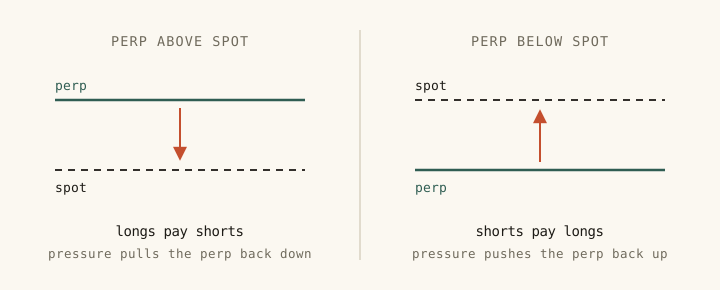
Every eight hours (on most exchanges, including Bybit), one side of the market pays the other. When the perp trades above spot, longs pay shorts, which nudges traders toward shorting and pulls the perp back down toward spot. When the perp trades below spot, shorts pay longs. The rate floats with the imbalance.
What it costs
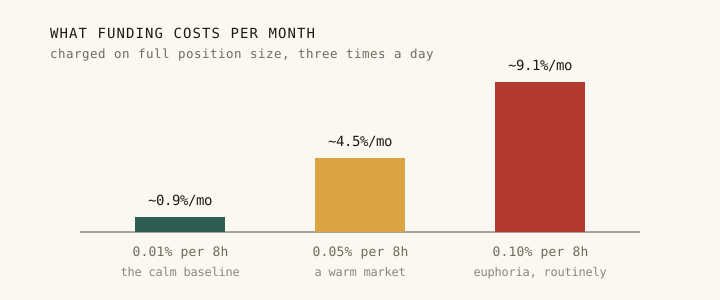
Funding rates look tiny: 0.01% is the common baseline. But it compounds against position size, three times a day, every day.
| Funding rate (8h) | Cost per month on the position |
|---|---|
| 0.01% | ~0.9% |
| 0.05% | ~4.5% |
| 0.10% | ~9.1% |
Two things make this bite harder than expected. First, funding is charged on the full position size, not your margin. At 10x leverage, a 0.01% funding rate is effectively 0.1% of your margin, every 8 hours. Second, funding spikes exactly when everyone agrees with you: euphoric markets routinely print 0.1% or higher, which is a 9%+ monthly headwind for being long alongside the crowd.
A leveraged long held through a euphoric month can be right about direction and still bleed: the funding drain lowers account equity, which (as covered in the liquidation explainer) quietly drags the liquidation price closer.
What it signals
Because funding measures the imbalance between longs and shorts, it doubles as a crowd-positioning gauge:
- High positive funding: longs are crowded and paying heavily for the privilege. Historically a caution signal; crowded trades unwind violently.
- Negative funding: shorts are paying longs. The crowd is bearish, and being long is, unusually, subsidised.
- Funding resets after a flush: liquidation cascades clear the crowd out, and funding normalising is one sign the reset happened.
None of these are trade signals on their own. They are context: a live reading of what the crowd is paying to believe.
The neutral trade that owns the fee
One more mechanic completes the picture. Because funding flows to the unpopular side, a market-neutral position can farm it: hold the asset spot, short the same size in the perp, and direction cancels out while the position collects funding whenever it is positive. This "cash and carry" or basis trade is why funding rarely stays extreme for long; professional capital arbitrages it back down.
It carries its own risks (funding flips negative, collateral management on the short leg, exchange risk on both), but knowing it exists explains a lot of market behaviour: those calm stretches where funding grinds back to baseline are arbitrage doing its job.
Education, not advice. Derivatives trading can lose more than your initial margin.