Open a 10x long and you have borrowed nine tenths of your position. The exchange is fine with this, because it holds your margin as security and it has an automated process that guarantees it never loses money on your loan. That process is liquidation, and it is not a penalty. It is the exchange protecting itself, mechanically, at a price it calculated the moment you opened the trade.
If you trade perpetuals without knowing that price, you are driving without knowing where the cliff is.
The mechanism
A leveraged position has three numbers that matter:
- Entry price — where you opened.
- Margin — the capital you posted (your position size divided by your leverage).
- Maintenance margin — the minimum equity the exchange requires you to keep, usually a small percentage of position value (around 0.5% for BTC at low tiers, rising with position size).
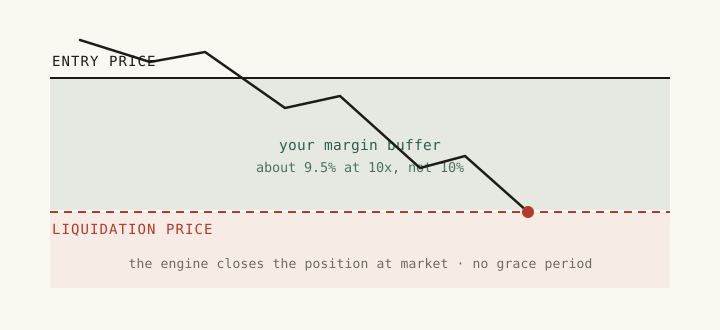
Your position's equity falls as price moves against you. When equity touches the maintenance margin requirement, the liquidation engine closes your position at market. You do not get asked. There is no grace period. The engine's job is to close you out while there is still enough margin left to cover the exit, and it errs on the side of the exchange, not you.
The math, roughly
For an isolated long position, the liquidation price is approximately:
liquidation ≈ entry × (1 − 1/leverage + maintenance margin rate)
At 10x with a 0.5% maintenance rate, that lands near 9.5% below entry. Not 10%. The maintenance margin eats into your buffer, and fees eat a little more. Traders who assume "10x means I can survive a 10% drop" discover the gap at the worst possible moment.
Run your own numbers in the liquidation price calculator. The pattern to internalise:
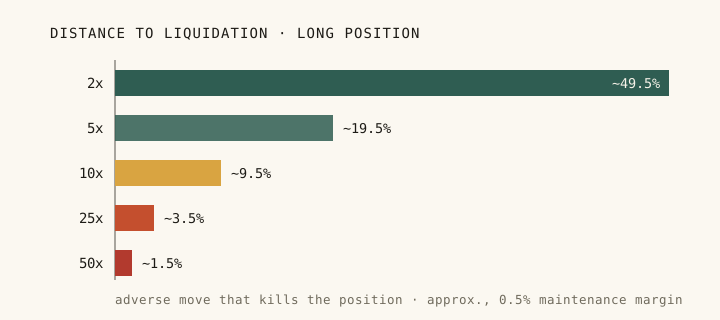
| Leverage | Approx. distance to liquidation (long) |
|---|---|
| 2x | ~49.5% |
| 5x | ~19.5% |
| 10x | ~9.5% |
| 25x | ~3.5% |
| 50x | ~1.5% |
At 50x you are betting that BTC does not wiggle 1.5%. BTC wiggles 1.5% while you make coffee.
What speeds it up
Funding. Perpetual longs usually pay a funding fee every 8 hours. It drains your margin slowly, which drags your liquidation price closer even if the market goes nowhere.
Cross margin surprises. In cross mode, your whole account balance backs every position. One bad trade can pull margin from everything else. Isolated margin caps the damage to what you posted, at the cost of liquidating sooner.
Cascades. Liquidations beget liquidations. When a cluster of 10x longs sits at the same level, the engine's forced selling pushes price into the next cluster. This is why crypto drops often look like an elevator with the cable cut. Your liquidation price does not exist in isolation; it sits in a crowd.
The defence is boring
The mechanics point to unglamorous conclusions. Lower leverage widens the cliff distance. Isolated margin makes the worst case knowable in advance. A stop loss placed before the liquidation price means you choose your exit rather than the engine choosing it for you, and you keep the maintenance margin the engine would have consumed.
None of this is a strategy. It is arithmetic. The traders who survive leverage are not the ones who predict the market; they are the ones who know exactly where their positions die and size them so that death is survivable.
This article explains exchange mechanics for education. It is not advice to trade with leverage, which can lose more than your initial margin.