Here is a trade that goes perfectly according to plan and still loses money.
A trader moves R10,000 offshore, opens a 10x long on bitcoin, holds it for two weeks, and closes it at exactly the price they opened it. No stop hit, no liquidation, no mistake. Price ended where it began. They then bring the money home.
They are down roughly R727, or 7.3% of their capital, and if they were careless about the route, closer to R1,708, which is 17%.
Nothing went wrong. That is the whole point of this article. Trading has a running cost that applies whether you are right, wrong, or neither, and almost everyone measures the wrong part of it.
The seven line items
A round trip from rand to rand has seven separate charges. Most traders can name two.
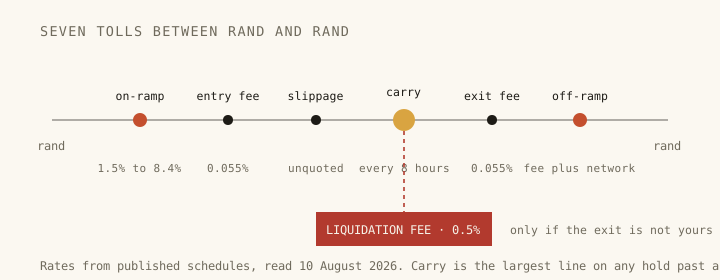
- The on-ramp. Rand into an offshore account, priced hop by hop here. Between 1.5% and 8.4% of your capital depending on four clicks.
- The entry fee. A taker order on Bybit's perpetuals costs 0.0550% of position size at VIP 0, a maker order 0.0200%.
- Spread and slippage. What you actually fill at, versus what you saw. Invisible, real, and worse on thin books and in fast markets.
- Carry. Funding on a perpetual, or interest on a spot-margin borrow. On a multi-day hold this is usually the largest single line, and the two rails price it completely differently, which is its own article.
- The exit fee. Same rate as entry, on the way out.
- The off-ramp. Stablecoin back across the border, back into rand, out to your bank.
- The liquidation fee. Only if the exit is not yours to choose. VALR publishes 0.5% on liquidation orders, spot and perpetual alike. This is the line item that turns a bad day into a worse one.
The receipt, filled in
R10,000 of capital, 10x, so a R100,000 position. Held 14 days. Closed flat. Perpetual rail, funding at the calm baseline of 0.01% per 8 hours. Taker in, taker out. Fees read from published schedules on 10 August 2026.
| Line | Charged on | Cost |
|---|---|---|
| On-ramp, deliberate route | R10,000 capital | ~R152 |
| Entry fee, 0.0550% | R100,000 position | R55 |
| Funding, 42 settlements at 0.01% | R100,000 position | R420 |
| Exit fee, 0.0550% | R100,000 position | R55 |
| Off-ramp back to rand | ~R9,300 | ~R45 |
| Total | ~R727 | |
| As a share of your R10,000 | 7.3% |
Now run the same trade for someone who used the card, the convenience button, and the network they half remembered from a forum post:
| Line | Cost |
|---|---|
| On-ramp, convenient route | ~R840 |
| Entry and exit fees | R110 |
| Funding, unchanged | R420 |
| Off-ramp, convenience button and an expensive network | ~R338 |
| Total | ~R1,708 |
| As a share of your R10,000 | 17.1% |
Same trade. Same market. Same outcome of nothing happening. A R981 difference, entirely from route selection.
The part that should reorganise your attention
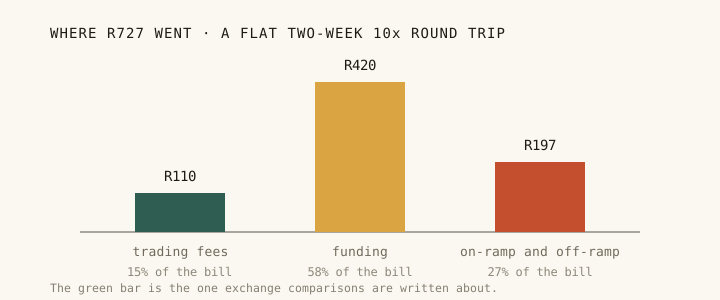
Look at where the money went in the careful version:
- Trading fees, the number quoted in every exchange comparison ever written: R110, 15% of the bill.
- Funding, the running cost of the rail you chose: R420, 58% of the bill.
- Getting money in and out: R197, 27% of the bill.
Traders will move venues over a 0.02% difference in taker fees and then pay 2% to a convenience button and 0.42% in funding without checking either. It is the same instinct that makes people drive across town to save R30 on petrol and then not read their bond rate.
Three consequences follow, and none of them is a trading opinion:
Leverage multiplies the carry, not just the outcome. Funding and fees are charged on position size, your capital is what absorbs them. At 10x, a 0.42% cost to the position is a 4.2% cost to you. At 25x it is 10.5%. The liquidation distance shrinks at the same time. Leverage compresses your margin for error from both ends at once.
Holding period changes which costs matter. For a trade measured in hours, funding is one settlement and rounds to nothing, and the entry and exit fees dominate. Past a few days, carry swamps everything, and the rail you chose matters far more than the fee tier you are on.
The on-ramp is a fixed cost on a variable base. It is nearly the same rand amount whether you deploy it once or twenty times. Someone transferring R10,000, trading it for a year, and bringing it home has paid the ramp once. Someone shuttling money back and forth every fortnight has paid it twenty-six times.
The one cost that is not really a cost
The on-ramp article points out that the stablecoin price in rand carries a premium over the interbank rate, 1.26% on the day of writing. That is a genuine cost when you are moving money offshore one way.
On a round trip it is subtler, and worth stating precisely: you buy the stablecoin at a premium and you sell it back at a premium. If the premium is the same on both days, you get it back. If it has narrowed while you were offshore, you lose the difference; if it has widened, you gain.
So the local premium on a round trip is not a fee, it is a position. You are, without being told, short the rand premium for the duration of your trade. It is small, it is usually stable, and it is one more thing sitting quietly on the ledger next to the trade you thought you were making.
The four numbers to know before entry
Not "is this trade good." That is your call and nobody else's. These are just arithmetic:
- What does the round trip cost me if the price never moves? Compute it before entry, as a percentage of your own capital, not the position.
- What does one more day of holding cost? At the current funding or borrow rate, in rand.
- How much of my cost is the ramp, and am I about to pay it again next week?
- What is the equivalent bill on the other rail? Same trade, spot margin instead of perpetual, or the reverse. The gap is routinely a factor of three.
A trade has to clear its own bill before it makes you anything. Most traders have never once written the bill down, which means they have a return target in mind that starts several percent below where they think it does.
Education, not advice. All fees are from the venues' published schedules read on 10 August 2026 and change without notice. The worked examples are illustrations of the arithmetic, not projections and not recommendations. Crypto assets are high risk; leveraged trading can lose more than your initial margin. Nothing here recommends a position, a leverage level, a venue, or a holding period.