Two South Africans move R10,000 from the same bank account to the same offshore exchange on the same morning. One arrives with about R9,847 of buying power. The other arrives with about R9,160.
Nothing separates them except four clicks: how the rand entered the exchange, which screen bought the stablecoin, which network carried it, and whether either of them looked at the price they were paying. None of those four choices is presented as a decision. All four are.
This article prices the route hop by hop, using published fee schedules and live quotes read on 10 August 2026. Rates change. The method does not.
The route
Getting rand onto a global exchange is not one transaction. It is a chain of four, and each link has its own toll booth:
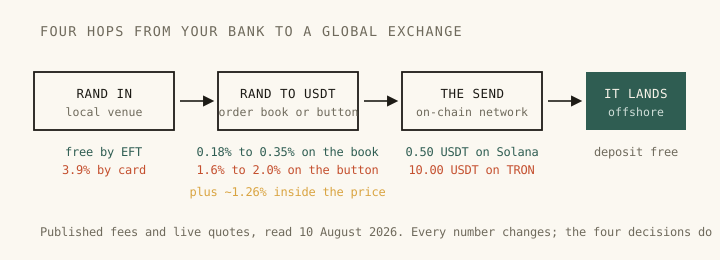
- Rand into a local licensed venue. Your bank to a South African crypto exchange.
- Rand into a dollar stablecoin. Almost always USDT or USDC, because that is what offshore venues quote in.
- The on-chain send. The stablecoin travels over a blockchain network to the offshore account.
- The deposit lands. Crypto deposits are normally free at the receiving end.
Hop one and hop three are pure fees. Hop two is where the real money goes, and only half of it is a fee at all.
Hop one: getting rand in
Free if you are patient, expensive if you are not.
| Method | VALR | Luno |
|---|---|---|
| Bank transfer (EFT) | Free | Free |
| Instant deposit | not offered as a rand deposit | 1.4% |
| Capitec Pay | not offered | 1.25% under R1,000, R9.00 over |
| Card | 3.9% | 3.9% (buys crypto directly) |
| Apple Pay | not offered | 2.5% |
Sources: VALR's published charges and Luno's South African fee schedule, both read 10 August 2026.
An ordinary EFT costs nothing and clears in hours. Paying by card costs R390 on R10,000 and clears in seconds. That is the going rate for impatience, and it is charged before you have bought anything at all.
Worth knowing before you start: Luno applies lifetime deposit and withdrawal caps of R15,000 at verification Level 1 and R50,000 a month at Level 2, with no limit once fully verified. Discovering that mid transfer is a bad time to discover it.
Hop two: rand into dollars, where the money actually goes
This hop has two prices. Only one of them is labelled.
The labelled price: the fee
Both local venues offer the same conversion on two different screens at wildly different prices.
| Buying USDT with rand | VALR | Luno |
|---|---|---|
| The convenience button | 1.6% (Simple Buy/Sell) | 2.0% (instant buy from the Portfolio screen) |
| The order book, taker | 0.350% | 0.20% |
| The order book, maker | 0.180% | minus 0.01% (a rebate) |
Same venue, same asset, same second. On R10,000, VALR's convenience button costs R160 and a taker order on its exchange costs R35. On Luno, the button costs R200, a taker order costs R20, and a resting limit order that someone else trades against pays you about R1.
The button is not a scam. It is a product: one tap, no order book, no limit price, no chance of getting it wrong. It is priced like a product too, at roughly five to ten times the order book, and that is the single most expensive habit in South African crypto.
Note the asymmetry in that table. For this specific hop, rand into a dollar stablecoin, Luno's exchange is materially cheaper than VALR's, because Luno prices USDT/ZAR as a near zero margin pair while VALR treats it as an ordinary fiat pair at 0.180% and 0.350%. On other pairs the ranking flips. There is no venue that wins every hop, which is why the honest answer is always "check the pair you are actually trading."
The unlabelled price: the gap
Now the part almost nobody measures. At the moment of writing, VALR's USDT/ZAR book showed an ask of 16.3601 while the spot USD/ZAR rate sat at 16.1565.
That is a gap of 1.26%, and you pay it whether you use the button or the order book, because it lives inside the price rather than beside it.
Three things make up that gap: the small difference between USDT and an actual dollar, the ordinary bid-ask spread, and a genuine local premium for dollars bought with rand. Buying dollars in a market where more people want out than in has always carried a price. Crypto did not invent it, it just made it visible on a public order book.
The practical point: on R10,000, that invisible 1.26% is R126, which is larger than every explicit fee on the deliberate route combined. Traders argue for hours about a 0.1% fee difference and never once compare the stablecoin price against the interbank rate on their phone.
One refinement, because it matters if the money is coming back. On a one-way transfer the premium is a straightforward cost: you have converted rand into offshore buying power at a rate 1.26% worse than interbank. On a round trip you buy at a premium and sell back at a premium, so you recover it if the premium holds and lose only the change in it. That makes it an exposure rather than a fee, and it is unpacked in the real cost of a round trip.
Hop three: choosing the network
The stablecoin now has to travel, and the network you pick is a dropdown that most people click through without reading. Here is what VALR publishes as its estimated send cost for USDT, from its public currency endpoint, read 10 August 2026:
| Network | Estimated send cost | Cost in rand | On a R10,000 transfer |
|---|---|---|---|
| Solana | 0.50 USDT | ~R8.18 | 0.08% |
| Ethereum | 0.71 USDT | ~R11.61 | 0.12% |
| TRON | 10.00 USDT | ~R163.56 | 1.64% |
Read that table twice, because it inverts the folk wisdom. TRON has spent years being recommended as the cheap network for moving USDT, and on this venue on this day it costs roughly twenty times what Solana costs and fourteen times what Ethereum costs. Network economics move around; the recommendation you half remember from a forum in 2023 does not.
Two rules survive every change in the table:
- Read the number on the withdrawal screen every single time. It is quoted before you confirm. The cheapest network last month is not automatically the cheapest today.
- The receiving venue must support the network you pick. Sending on a chain the destination does not credit is the one mistake on this entire route that can cost you the whole amount rather than a fee. Send a small test amount first, confirm it lands, then send the rest. The test costs you one extra network fee. Not testing has cost people everything they sent.
The two routes, priced
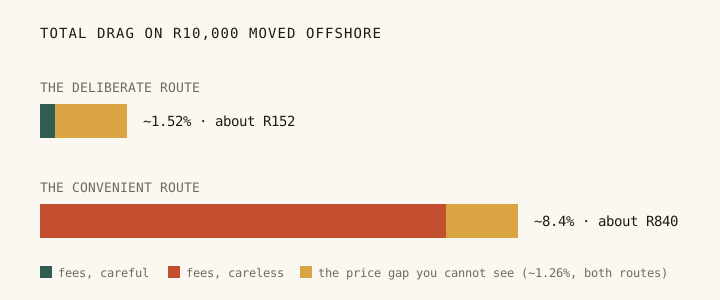
The same R10,000, same destination, same morning.
| The deliberate route | The convenient route | |
|---|---|---|
| Rand in | EFT, free | Card, 3.9% = R390 |
| Rand to USDT | order book, maker 0.180% = R18 | convenience button, 1.6% = R160 |
| The send | Solana, ~R8 | TRON, ~R164 |
| Explicit fees | ~R26 (0.26%) | ~R714 (7.1%) |
| The price gap | ~R126 (1.26%) | ~R126 (1.26%) |
| Total drag | ~1.52% | ~8.4% |
Figures computed on the R10,000 starting amount for readability rather than compounding each fee on the reducing balance; the real numbers land within a few rand of these.
The difference is R688 on a single R10,000 transfer. Nobody trades their way to R688 on R10,000 in a hurry, and yet the entire gap is available for free, once, by reading four screens more carefully.
The layer above the fees: exchange control
Fees are the small print. Exchange control is the actual rulebook, and it changed a week before this article was published.
The standing position for a resident individual is two allowances. The single discretionary allowance was raised in the 2026 Budget from R1 million to R2 million a year and needs no tax clearance. Above that, the foreign capital allowance covers up to R10 million a year and does require a tax compliance status pin from SARS.
On 3 August 2026, the South African Reserve Bank and National Treasury published a draft Crypto Asset Manual for Cross-Border Activities, open for public comment until 30 September 2026. It is the first time cross-border crypto movement has been given its own formal rulebook rather than being reasoned about by analogy. As drafted, it sets out that:
- Sending crypto from a South African authorised provider to an offshore venue or to a self-custody wallet counts as a cross-border transaction, reportable to Financial Surveillance, and it runs against those same two allowances.
- Only natural persons may externalise crypto assets. Resident companies and trusts are expressly excluded.
- Authorised providers face real thresholds, including minimum unimpaired capital of R5 million, local registration with a physical presence, and full customer due diligence.
- Activity is banded into categories, with the entry band capping remittances at R5,000 a day and R25,000 a month.
- Transfers from non-custodial wallets into domestic providers are prohibited as drafted.
Two honest caveats. First, this is a draft, not law; the comment window is still open and the final version may differ. Second, the direction of travel is unmistakable: the informal era of moving crypto across the border without anyone counting it is closing, and the reporting is being built into the licensed venues rather than left to the individual. Anyone moving meaningful sums should be talking to a professional about their own allowance position rather than reasoning from an article.
The four questions
Before the next transfer, in the order the money moves:
- Am I paying for speed at the deposit, and do I actually need it today?
- Am I on the convenience button or the order book, and what is the difference in rand on this amount?
- What is the stablecoin price against the live interbank rate right now?
- What does the withdrawal screen say this network costs today, and has a test amount landed?
Four questions, roughly two minutes, and on a R10,000 transfer they are worth several hundred rand. On a recurring monthly transfer they are worth a great deal more, because this is the one cost in trading that repeats forever and has nothing to do with being right about the market.
Education, not advice. All fees quoted are from the venues' own published schedules and public endpoints, read on 10 August 2026, and change without notice. Live prices are readings at a moment in time. Crypto assets are high risk. Nothing here recommends a venue, a network, an amount, or a transaction, and nothing here is tax or exchange control advice; speak to a registered professional about your own position.