There is a belief, widespread and expensive, that crypto tax happens when you cash out. Hold, swap, rotate, compound, do whatever you like inside the account, and the taxman only appears when rand hits your bank.
It has never been true, and as of this year it is not even quietly true. On 1 March 2026 South Africa's crypto reporting regime took effect. The first reporting period runs to 28 February 2027, the first returns from crypto providers are due to SARS by 31 May 2027, and the first automatic exchange of that information between countries happens in September 2027.
Meanwhile, on 1 July 2026, SARS published its first comprehensive Draft Guide to the Taxation of Crypto Assets, open for public comment until 31 August 2026. It is the clearest statement yet of how the revenue authority sees this asset class, and several of its positions will surprise active traders.
This is an explainer, not advice. Tax is specific to your circumstances and this article cannot know yours.
What crypto is, in tax terms
SARS classifies crypto assets as intangible assets. Not currency, not money, not shares, not assets on a recognised exchange. They fall inside the definition of a "financial instrument" in the Income Tax Act.
That sounds like paperwork. It has three sharp consequences.
Ordinary tax rules apply, the same ones used for other intangible assets. There is no special crypto regime, no special rate, and no exemption waiting to be discovered.
Crypto is not foreign currency. Rules that soften the treatment of foreign exchange movements do not reach it.
The three-year safe harbour does not apply. This is the one that catches people. Under section 9C of the Income Tax Act, if you hold shares for three years or more, the proceeds are deemed to be capital in nature, full stop. It is a bright line and it protects long-term share investors from an argument with SARS. There is no equivalent for crypto assets. Holding bitcoin for five years does not automatically make the gain capital. It is evidence, not a guarantee.
Revenue or capital, and why it decides everything
The single question that determines your tax bill is whether your gains are revenue in nature or capital in nature. The difference is not marginal.
| Revenue | Capital | |
|---|---|---|
| Taxed as | ordinary income | capital gain |
| Rate for an individual | 18% to 45% marginal | 40% inclusion rate, so a maximum effective 18% |
| Annual exclusion | none | R50,000 for 2026/27 |
| Losses | deductible against income, subject to ring-fencing rules | offset against capital gains only |
For a taxpayer at the top marginal rate, the same R100,000 gain is roughly R45,000 of tax if it is revenue and roughly R18,000 if it is capital. Same profit, two and a half times the bill.
So how is it decided? The draft guide is blunt: the Act contains "no single infallible test of invariable application." SARS weighs the whole picture, including:
- Your intention at acquisition, throughout the holding period, and at disposal. Intention can change; a coin bought to hold and later traded actively can change character.
- The frequency and nature of your transactions.
- The holding period, and whether you appear to be exploiting short-term volatility.
- Whether the asset produces an ongoing income stream.
And explicitly: neither a long holding period nor infrequent trading is automatically decisive. All the facts get considered.
Read that list from the point of view of someone trading perpetual futures. Frequent transactions, short holds, explicitly positioned to profit from price movement, using leverage to amplify it. There is no serious argument that this is capital in nature. Active derivatives trading sits firmly on the revenue side, taxed at your marginal rate, and traders who have been mentally applying an 18% effective rate to their trading profits have been budgeting for a different tax than the one they owe.
The flip side is real too: if your trading is revenue in nature, your losses are ordinary deductions rather than trapped capital losses, subject to the ring-fencing provisions for suspect trades. Consistency matters. You cannot be a capital investor in the winners and a revenue trader in the losers.
The event that catches almost everyone
Here is the position that quietly reprices most people's tax year.
A crypto-to-crypto swap is a barter transaction, and it is taxable at the moment of the swap. The draft guide states directly that income tax and CGT consequences arise then and are "not deferred until the crypto asset is sold for fiat money."
You disposed of one asset and acquired another. That the proceeds arrived as a different token rather than as rand changes nothing.
The practical implications compound quickly:
- Selling BTC for USDT is a disposal of BTC, valued in rand at that moment.
- Rotating between coins is a chain of disposals, each one an event, each one needing a rand value on the day.
- Someone who never withdrew a cent to their bank account can still owe a substantial amount of tax.
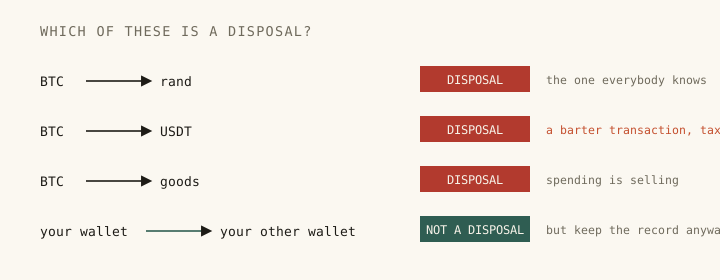
The corollary is the one that saves people: moving crypto between your own wallets or accounts is not a disposal. You still owe yourself the record, because otherwise it looks exactly like a disposal to anyone reconstructing your year afterwards, including you.
Mining, staking and airdrops
The draft guide treats these separately from trading, and the distinctions are cleaner than most people expect:
- Mining is treated as carrying on a trade. Rewards are included in gross income at market value when received.
- Staking rewards follow similar principles.
- Airdrops depend on how they arrived. A passive drop into a wallet is treated differently from tokens earned through services, promotional work, or an activity you performed.
In each case there are typically two events, not one: income when you receive the asset, and then a second calculation when you eventually dispose of it, with your base cost set by the value already taxed.
The record-keeping requirement is the actual work
Taxpayers must keep records for at least five years from the date the return was submitted, or five years from the end of the relevant period where no return was required. Those records need to support market values, base costs, gains and losses, and the revenue-or-capital nature of what you did.
For an active trader this is not a filing task, it is a data problem. Every swap needs a rand value at the time it happened, across venues that quote in dollars, with a currency that moves while you sleep. The realistic options are keeping a disciplined running log from the start, or using crypto tax software that reconstructs it from exchange exports. Both are far cheaper than the third option, which is trying to rebuild three years of activity from memory under a SARS query.
Why "they cannot see it" stopped being a strategy
Two things have closed at once, and they close from opposite directions.
The Crypto-Asset Reporting Framework is an OECD global standard that South Africa has implemented. Crypto asset service providers now collect and report transaction information to SARS, and that information is exchanged between participating jurisdictions. The first period is being collected as you read this; the first international exchange happens in September 2027. This is the same machinery that ended banking secrecy for ordinary taxpayers, pointed at crypto.
From the other side, the draft Crypto Asset Manual for Cross-Border Activities published on 3 August 2026 brings the movement of crypto across the border into the exchange control reporting system, as covered in the on-ramp article.
Being offshore was never a tax position for a South African tax resident, who is taxed on worldwide income and gains regardless of where the venue sits. What has changed is that it is no longer an obscurity position either.
The questions to take to someone qualified
You will get a better answer, faster and cheaper, if you arrive with these already thought through:
- Across all my activity, is this revenue or capital, and can I state honestly why?
- Have I treated every crypto-to-crypto swap as a disposal, or only the withdrawals to my bank?
- Can I produce a rand value at the time for each disposal, and do I have the exports to prove it?
- Have mining, staking or airdrop receipts been declared as income when received?
- Are there prior years that need correcting before the reporting machinery reaches them?
The traders who get hurt here are rarely the ones who evaded anything. They are the ones who assumed the tax event was the withdrawal, rotated positions cheerfully for three years, and only discovered the arithmetic when someone asked for it. The cost of finding out early is an afternoon and a practitioner's fee. The cost of finding out late is a penalty and interest on top of a bill you already could not fund, because the profits were reinvested and the market has since moved.
Education, not advice, and specifically not tax advice. Based on the SARS Draft Guide to the Taxation of Crypto Assets (published 1 July 2026, open for comment until 31 August 2026), SARS's published CARF material, and the 2026 Budget. Tax outcomes depend entirely on individual circumstances. Speak to a registered tax practitioner about your own position.