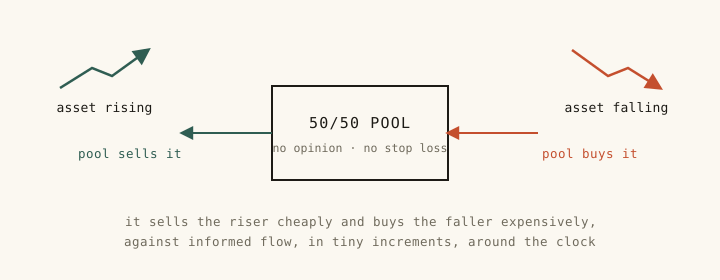
Providing liquidity feels like earning passive income on coins you already own. Mathematically, you have sold your winners on the way up, automatically, forever.
Structure02 Jul 2026·8 min read·CoinRoom Research
The name is the problem. "Impermanent loss" sounds like a temporary paper cut, something that heals if you wait. What it actually describes is this: the moment you deposit two assets into a 50/50 liquidity pool, you have changed your position. You no longer own the two assets. You own a machine that continuously sells whichever one is going up and buys whichever one is going down.
Sometimes that is exactly what you want. But most people who provide liquidity think they are holding their coins and collecting a toll. They are not. Understanding the difference is the entire game.
What the pool actually does
An automated market maker keeps the pool balanced by value. If you deposit R10,000 of ETH and R10,000 of USDC, the pool holds them 50/50. When ETH rises, arbitrage traders buy ETH out of your pool (cheaply, from you) until the balance is restored. When ETH falls, they sell ETH into your pool (expensively, to you).
Every rebalance is you, structurally, trading against informed flow. The pool has no opinion, no timing, no stop loss. It just sells rises and buys dips, in tiny increments, around the clock.
What a 50/50 pool does with your deposit: it becomes a machine that sells rises and buys dips, automatically, forever.
The number
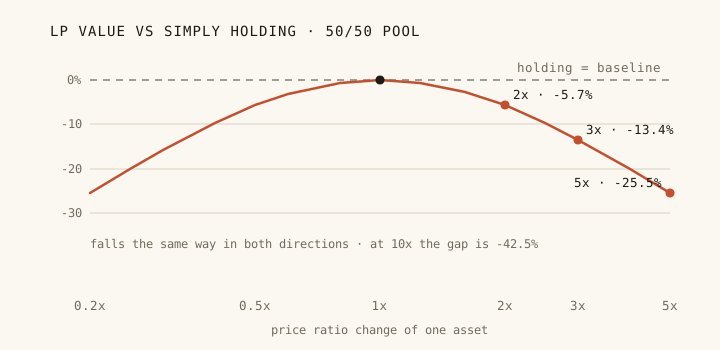
Compare the pool position against simply holding the same two assets, for a given price move in one of them:
Price change of one asset
LP vs holding
+25%
−0.6%
+100% (2x)
−5.7%
+300% (4x)
−20.0%
+900% (10x)
−42.5%
−50%
−5.7%
The formula behind the table, for a 50/50 pool where the price ratio changes by r: IL = 2√r ÷ (1 + r) − 1. Drag the slider to feel how it accelerates:
The gap between providing liquidity and holding, from the formula above. It is shallow near 1x and accelerates fast.
Read the 10x row again. If one of your pooled assets does a 10x, you gave up more than 40% of the gain you would have had by holding. "Impermanent" only means the loss is unrealised until you withdraw. If the price never returns to your entry ratio (and why would it?), the loss is as permanent as any other.
The stablecoin pair, concretely: BTC/USDC
Pool BTC against a stablecoin and the machine gets much easier to picture, because only one side moves. Every time BTC rises, the pool sells a little of your BTC into USDC. Every time BTC falls, the pool spends your USDC buying BTC. You have built an automated take-profit and buy-the-dip machine, with no emotions and no off switch.
The numbers, using the same R10,000 + R10,000 deposit as before:
BTC move
What the pool did
Your position becomes
vs holding
+50%
sold ~18% of your BTC units on the way up
R12,247 BTC + R12,247 USDC
−2.0% (R24,495 vs R25,000)
−30%
bought ~20% more BTC units on the way down
R8,367 BTC + R8,367 USDC
−1.6% (R16,733 vs R17,000)
Read the table as two personalities. On the way up, the pool is the disciplined friend who trims your position and banks the profit in stablecoins (that is the USDC side growing from R10,000 to R12,247). On the way down, it averages into BTC while your stablecoin reserve shrinks. Both are things traders swear they will do manually and then do late, or not at all. The pool does them instantly, in tiny increments, without asking.
The catch is the same one this whole article is about: the machine never stops. It keeps taking profit all the way through a 10x (that is how you give up 42.5% of the gain), and it keeps buying the dip however deep the dip goes; there is no level where it decides BTC has fallen enough. Paired with fee income, a ranging BTC can make this position genuinely productive. In a strong trend, either direction, you would have been better off picking a side.
So why does anyone provide liquidity?
Because of the other side of the ledger: trading fees and incentives. Liquidity provision is profitable when fees earned > impermanent loss incurred. That happens in pools where volume is enormous relative to volatility (major stablecoin pairs) or where the two assets track each other closely, so the ratio barely moves.
It tends to go badly in exactly the pools that look most exciting: volatile new tokens paired against stables, where the advertised APR is high precisely because the IL risk is severe. The APR is the bait; the IL is the hook.
The reframe that protects you: providing liquidity is selling volatility. You are running a strategy that profits when prices go sideways and bleeds when they trend. If you have a strong view that an asset will trend up, a pool is a machine for turning your best idea into somebody else's cheap entry.
The question to ask before pooling
Not "what is the APY?" but: am I happy to be systematically selling this asset as it rises? For a pair you genuinely want to hold in balance, with fat fee volume, the answer can be yes. For the coin you bought because you believe in it, the answer is almost always no.
The pool is not evil. It is a position with a specific payoff shape. The only mistake is not knowing you put it on.
Education, not advice. DeFi liquidity provision carries smart contract risk on top of the market mechanics described here.
Put it into practice
These mechanics work the same anywhere. We teach with Bybit for its perp depth and collateral flexibility.